

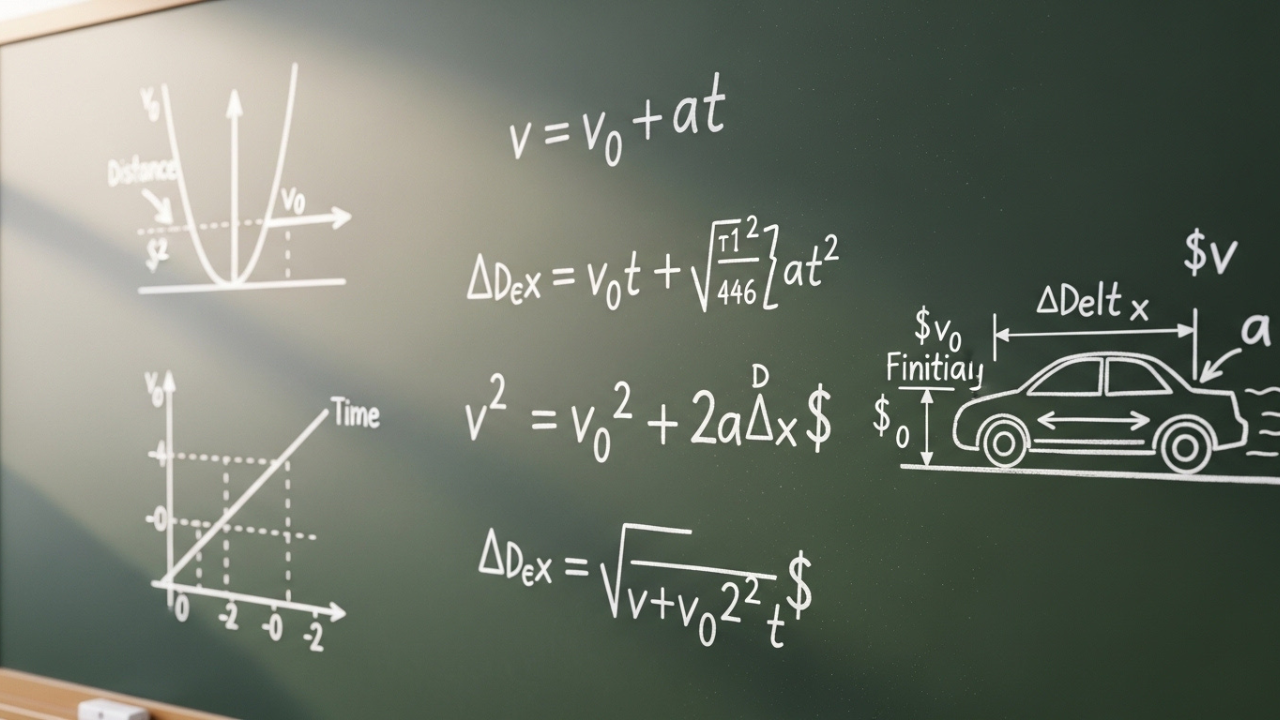
Kinematic equations are the backbone of classical mechanics, acting as a bridge between motion and mathematics. Whether you’re launching a rocket or simply tossing a ball in the park, these equations govern how objects move through space and time. They provide us with essential tools to predict where an object will be at any given moment based on its initial conditions.
But what exactly are kinematic equations? Why do they matter? In this post, we’ll dive into their formulas, explore derivations that simplify complex concepts, and illustrate real-world applications that highlight their importance. From everyday scenarios to advanced physics problems, understanding kinematic equations opens up new ways of seeing the world around us. Strap in for an engaging journey through motion!
Kinematic Equations Explained: Formulas, Derivations & Real-World Examples
Kinematic equations describe the motion of objects in a straight line. These formulas relate displacement, initial velocity, final velocity, acceleration, and time. The four primary kinematic equations serve as powerful tools for solving various physics problems involving linear motion.
Deriving these equations starts with basic principles of constant acceleration. By manipulating fundamental definitions—like average velocity and acceleration—these relationships emerge naturally from the underlying concepts of motion. Understanding how they’re derived enhances your grasp on their practical applications.
In real life, we encounter kinematic scenarios daily—from cars accelerating at traffic lights to athletes sprinting down a track. Each situation can be analyzed with these equations to predict outcomes or understand the dynamics involved in movement effectively. Whether it’s calculating stopping distance or timing a race, kinematic equations provide clear insights into our moving world.
Introduction to Kinematic Equations
Kinematic equations describe the motion of objects in a straightforward manner. They play a crucial role in physics, allowing us to analyze how an object moves under various conditions. Understanding these equations is fundamental for anyone studying mechanics.
These equations relate key variables such as displacement, velocity, acceleration, and time. With just a few formulas at your disposal, you can solve complex motion problems that arise in everyday life.
Whether you’re calculating the distance traveled by a car or predicting where a thrown ball will land, kinematic equations provide essential insights into movement. By grasping these concepts, you’ll unlock a deeper understanding of how the world works around you.
Derivation of Kinematic Equations
Kinematic equations can be derived from basic principles of motion. Starting with the definition of acceleration, we know it is the rate of change of velocity over time. If we express this mathematically, we find that velocity is equal to initial velocity plus acceleration multiplied by time.
Next, consider how displacement relates to velocity. Displacement can be expressed as the integral of velocity over time. By substituting our earlier expression for velocity into this equation, we derive a formula for displacement in terms of initial and final velocities along with acceleration and time.
The beauty lies in combining these variables into four distinct kinematic equations. Each equation serves unique scenarios—whether it’s constant speed or varying acceleration—allowing us to analyze motion accurately across various contexts.
Kinematic Equations for Linear Motion
Kinematic equations for linear motion describe the relationship between an object’s displacement, velocity, acceleration, and time. These equations are essential tools in physics that help us understand how objects move under constant acceleration. They simplify complex movements into manageable calculations.
The most common kinematic equations include \( v = u + at \), where \( v \) is final velocity, \( u \) is initial velocity, \( a \) is acceleration, and \( t \) represents time. Another crucial equation is \( s = ut + \frac{1}{2}at^2\), which calculates displacement over time with constant acceleration.
These formulas allow scientists and engineers to predict movement accurately. Whether analyzing a car’s speed or determining the trajectory of a projectile, these equations play a critical role in various fields including engineering and robotics. Understanding them can lead to better problem-solving strategies in real-world applications.
Forward Kinematics in Real Life
Forward kinematics is all around us, often in ways we don’t realize. For instance, consider a robotic arm used in manufacturing. The precision with which it moves depends on understanding forward kinematics to predict its end effector’s position based on joint angles and lengths.
In animation, artists use forward kinematics to create realistic character movements. By adjusting the joints of a digital puppet, animators can simulate lifelike gestures that enhance storytelling without losing track of each limb’s position.
Even in video games, developers apply these principles to control character motions smoothly and responsively. Players experience seamless interactions as characters navigate their environments while adhering to physical laws derived from kinematic equations. These real-world applications showcase the importance of understanding motion beyond theoretical frameworks.
Real-World Applications of Kinematic Equations
Kinematic equations are not just confined to textbooks; they play a crucial role in our daily lives. From the moment you step into a car, these equations help determine how fast you’ll reach your destination. They calculate stopping distances and acceleration rates, ensuring safe travel.
Sports also rely on kinematic principles. Whether it’s a soccer ball soaring through the air or an athlete sprinting down the track, understanding motion helps improve performance. Coaches use kinematic data to analyze athletes’ techniques and enhance their training regimens.
Even in video game design, kinematic equations guide character movement and physics simulation. Game developers utilize these formulas to create realistic experiences that immerse players in dynamic worlds where every jump or dash follows precise rules of motion.
Problem-Solving Strategies using Kinematic Equations
When tackling problems involving kinematic equations, it’s essential to start by identifying the known variables. Determine what information you have and what you’re trying to find. This could include initial velocity, final velocity, acceleration, time, or displacement.
Next, choose the appropriate kinematic equation based on your given values. There are four main equations in this category that can help solve various motion problems. Each equation relates different variables together and is useful for different scenarios—like constant acceleration.
Ensure you pay attention to units when calculating your answers. Consistency in unit measurement prevents confusion and potential errors in solutions. If necessary, convert units before applying them into the equations for a seamless problem-solving experience.
Conclusion & Next Steps
Kinematic equations are fundamental tools in understanding motion. They help us predict how objects move under various conditions. By mastering these equations, you can enhance your problem-solving skills and apply them to a wide range of scenarios.
To deepen your knowledge, consider practicing with real-world examples. Analyze the motion of vehicles or sports activities to see kinematic concepts in action. You could also explore online simulations that allow you to manipulate variables like velocity and acceleration.
As you continue learning, challenge yourself with more complex problems involving multiple dimensions and forces. This will build a stronger foundation for future studies in physics or engineering.
Remember, the world around you is filled with movement governed by these principles. Your exploration doesn’t have to end here; there’s always something new to discover about kinematics and its applications!