
INTRODUCTION
The first time I watched a tourist eat ema datshi, I saw a transformation that bordered on theatrical. She was a perfectly pleasant American woman from Seattle, seated across from me at a buffet in Paro, who had been nervously circling the chafing dishes. She scooped a tiny spoonful of the chili-and-cheese stew onto the edge of her plate, her expression preparing for pain. Five minutes later, she was going back for thirds, laughing at her own trepidation, her forehead glistening with a sheen of happy sweat. “I don’t even like spicy food,” she confessed, “but this feels different. It’s not just heat—it’s comfort.”
This is the central promise I make to every curious tourist. Yes, food in Bhutan for tourists can feel intimidating at first glance: a landscape of chilies, unfamiliar cheese, and broths that look more like survival rations than vacation indulgence. But the reality is infinitely more nuanced, deeply accommodating, and almost guaranteed to be one of the most memorable threads of your journey. This guide isn’t a dry list of dishes. It’s a road map for eating your way through the Land of the Thunder Dragon with confidence, joy, and zero regrets. Whether you are a hardcore carnivore, a strict vegan, or someone who considers black pepper too spicy, by the end you’ll know exactly what awaits you, where to find it, and why your fork might become the single best tool for understanding happiness itself.
THE TOURIST TABLE IS SET
To grasp what food in Bhutan for tourists really looks like, you first have to understand the unique architecture of travel here. Bhutan operates a “High Value, Low Impact” tourism policy. Nearly all foreign visitors (except Indian, Bangladeshi, and Maldivian nationals) must pay a daily Sustainable Development Fee and book their trip through a licensed Bhutanese tour operator. This single fact orchestrates 90% of your meals. Your itinerary will typically include breakfast and dinner at your hotel and lunches at designated tourist restaurants along your route. This system ensures consistent hygiene, reliable supply, and a safety net for foreign stomachs—but it can also create a culinary bubble, a slightly sanitized version of Bhutanese cuisine designed not to terrify anyone.
However, the bubble is deflating beautifully. Independent cafes and local eateries are booming in Thimphu, Paro, and Punakha. Tourists with a little initiative can slip away from the buffet and discover a parallel world of street-side momo stalls, third-wave coffee shops, and farmhouse kitchens where the ezay is so fresh it hums. Why does this matter? Because food is one of the deepest expressions of Bhutanese culture, and limiting yourself to hotel butter toast and mild kewa datshi is like visiting Italy and only eating spaghetti bolognese at the airport. The trend among savvy travelers is shifting toward culinary immersion, and Bhutan, with its carbon-negative farms, monastic vegetarian traditions, and the world’s most audacious use of chili, is ripe for exploration.
THE TOURIST BUFFET AND BEYOND: UNDERSTANDING YOUR DAILY FOOD RHYTHM
Most guided tours package meals into a predictable, if generous, routine. Breakfast at the hotel usually offers a spread of both Western and Bhutanese items: toast, eggs, and cereal sit alongside khur-le (buckwheat pancakes), porridge, and maybe a pan of vegetables in a mild cheese sauce. A wise tourist will lean toward the local. Buckwheat pancakes with a drizzle of local honey and a cup of butter tea (suja) give you a savory, energy-dense start that a plain omelet never will.
Lunch is the great equalizer. At tourist restaurants, buffets are the norm—steamed red rice, two or three datshi variations, a lentil soup, some stir-fried vegetables, and a meat dish or two. The spice levels here are calibrated for foreign palates: the ema datshi might contain fewer chilies, and you’ll often find a completely non-spicy dal. This is the safe zone. For many tourists, this is where they fall in love with the creamy texture of potato-and-cheese stew and realize that Bhutanese food doesn’t have to be punishing.
Dinner is where the tourist experience can diverge wildly. Hotel dinners may mirror lunch, or they may go upscale, especially in Thimphu’s boutique hotels where chefs are experimenting with plated presentations of local ingredients. But the real magic happens when you ask your guide to take you to a local restaurant, or if you’ve booked a farmhouse homestay, where the food is home-cooked, seasonal, and loaded with personality. One evening in a Punakha farmhouse, I watched a family matriarch grill whole fresh chilies over an open fire, stuff them with butter and salt, and hand them around like canapés. No tourist restaurant would ever serve that, and it was sublime.
THE MUST-EAT DISHES: NAVIGATING A MENU WITH CONFIDENCE
You can’t eat in Bhutan without meeting the holy trinity of datshi dishes. Ema datshi is the national icon: fresh, split green or red chilies cooked with local cow or yak milk cheese. The heat is bright, but the dairy cushions it into something almost cravable. If you’re genuinely worried about spice, start with kewa datshi (potato and cheese), which is creamy, earthy, and often made with just a whisper of chili. For a deeper, woodsier flavor, shamu datshi (wild mushroom and cheese) is pure umami comfort.
Move beyond cheese stews and you’ll find momos—the universal Bhutanese snack. These Tibetan-descended dumplings come stuffed with minced cabbage, onion, and cheese (vegetarian), or with beef or chicken. Tourists often make a meal of a dozen momos at a local joint like Zombala in Thimphu, where the hot sauce on the side is fiery enough to require a second glass of milk tea. Speaking of which, suja (butter tea) and ngaja (sweet milk tea) are your two essential beverages. The former is salty, rich, and deeply polarizing; the latter is sweet, milky, and a safe bet for anyone.
Don’t overlook ezay, the fresh chili condiment that accompanies almost every meal. Made from chopped chilies, garlic, onion, tomato, and sometimes Sichuan pepper, it’s the Bhutanese equivalent of salsa, and it transforms even plain rice. For meat-eaters, phaksha paa (pork with dried chilies and radish) and jasha maroo (spicy minced chicken) are the go-to proteins. And for breakfast, a bowl of red rice with a fried egg and a side of sautéed fern greens (nakey) is the simplest, most honest meal you’ll have all trip. The key to ordering is to be direct with your guide or server: “Please make it mild” works, but “less chili, please” works better. Bhutanese hospitality is so warm that they will genuinely try to protect you from discomfort, sometimes to the point of making you a separate, non-spicy batch.
EATING FOR EVERY DIET: VEGETARIAN, VEGAN, GLUTEN-FREE, AND THE SPICE-AVERSE
One of Bhutan’s best-kept tourist secrets is how brilliantly it caters to vegetarians. The Buddhist principle of non-harm has produced a massive plant-forward repertoire. Vegetarians can feast on ema datshi, kewa datshi, shamu datshi, vegetable momos, lentil soups, fern and cheese stews, and endless permutations of sautéed seasonal greens. You will never, ever go hungry. Vegans face a steeper but absolutely manageable challenge. The catch is dairy: butter and cheese are foundational. However, most tour operators and hotels now handle vegan requests with aplomb. You’ll be served dal without butter, vegetables sautéed in oil, buckwheat noodles with tomato-based sauces, and fruit. Learn the phrase “nga-la cheese ma-ga” (I don’t eat cheese) or have your guide advocate for you.
Gluten-free travelers are in luck. Buckwheat, a naturally gluten-free grain, is ubiquitous in the form of noodles (puta) and pancakes. Red rice is, of course, gluten-free. Soy sauce isn’t a traditional Bhutanese ingredient, so cross-contamination risks are lower than in many other Asian cuisines. As for the spice-averse, I’ll level with you: you’ll need to be proactive, but you will eat well. Potato dishes, boiled vegetables, plain rice, and egg dishes are your lifelines. The tourist buffet almost always has at least two non-spicy options. Some travelers I’ve met survived gorgeously on kewa datshi and momos alone, leaving Bhutan with a newfound tolerance for mild chilies they never imagined possible.
WHERE TO EAT: A CRASH COURSE IN BHUTANESE DINING SCENES
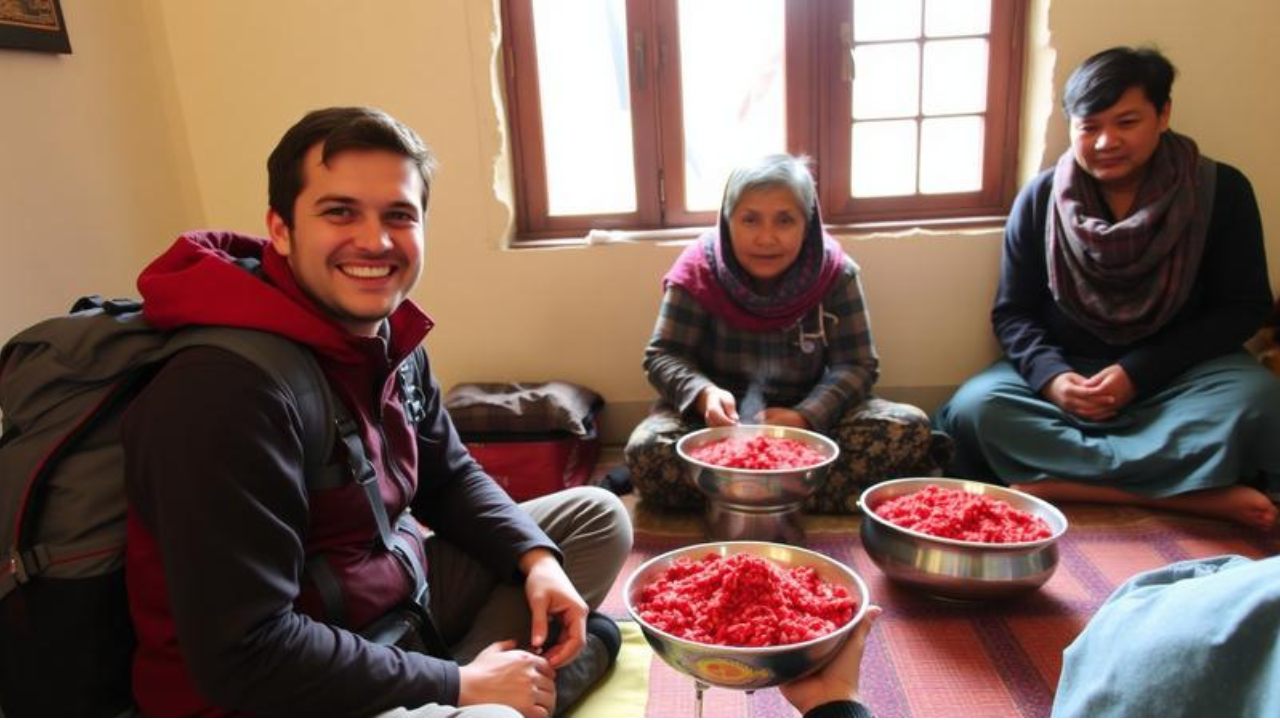
The most rewarding meals for a tourist rarely come from a menu in a hotel lobby. Homestays are the crown jewel. Farmhouse stays offer a chance to eat in a traditional kitchen, often seated on the floor around a bangchung (bamboo serving basket). The food is what the family eats, which means it’s authentic, seasonal, and served with overwhelming generosity. You’ll be urged to second and third helpings with a laugh and a “Mey na, mey na” (Eat, eat).
In Thimphu, the capital’s food scene has evolved far beyond the tourist buffet. The Zone and Ambient Café serve excellent coffee, smoothie bowls, and Bhutan-inspired global comfort food—a welcome break if you’re craving a salad. For momos, Zombala and The Bhutan Kitchen are institutions. The weekend Centenary Farmers’ Market is a sensory overload of dried chilies, fern fronds, balls of homemade cheese, and stacks of pink rice. You can’t eat a meal here, but you can snack on roasted corn, tiny bananas, and squares of dried yak cheese.
In Paro, Sonam Trophel Restaurant offers reliably delicious local fare in a family-friendly setting. Many tourists also book a hot stone bath dinner experience, where you soak outdoors while nibbling on snacks before a hearty meal. In Punakha, riverside restaurants serve meals with a view of the terraced fields. Everywhere, the act of eating connects you to the landscape. And don’t skip the opportunity to try ara, the warm, cloudy home-brewed spirit, offered in a welcoming home with a fried egg on top. It’s a ritual, not a drink.
COUNTERARGUMENT OR NUANCE: WHEN THE FOOD BECOMES TOO MUCH
I would be a dishonest advocate if I didn’t admit that some tourists genuinely struggle. The phrase “a little repetition” is charitable. After a week of moving through similar valleys and similar buffets, the recurring presence of cheese and chili stew can start to blur. Breakfasts can feel monotonous, especially if you don’t enjoy savory porridge or buckwheat. Some travelers experience digestive discomfort, not necessarily from spice or hygiene, but simply from a radical shift in diet, altitude, and the richness of dairy.
Moreover, the all-inclusive tour system, while efficient, can insulate you so thoroughly that you never taste a truly fiery ezay or meet a local grandmother who insists you try her fermented radish. The very structure designed to protect tourists can flatten a cuisine’s wild edges. The solution isn’t to reject the system but to lean out of it deliberately. Ask your guide, “Where do you eat with your friends?” This simple question has led travelers to hole-in-the-wall dumpling dens and backstreet noodle shops that they talk about for years. Acknowledge the possible fatigue, and you empower yourself to subvert it.
ACTIONABLE TAKEAWAYS
-
Use Your Guide as a Culinary Key: Your Bhutanese guide is your greatest asset. Explicitly say, “I want to eat where you eat, even if it’s just a momo stand. I’m not afraid of spice, but I want it adjusted.” They will make it happen.
-
Start with Potato, Graduate to Chili: If you fear the burn, order kewa datshi on day one. By day three, you’ll be spooning ema datshi over your rice with confidence.
-
Pack Digestive Comforts: Bring probiotics, charcoal tablets, or familiar granola bars. Not because the food is unsafe, but because your gut may need a bridge between your home diet and a sudden influx of butter and chilies.
-
Request the Local Breakfast: Skip the toast. Ask for khur-le (buckwheat pancakes), a bowl of red rice with a fried egg, or thukpa (noodle soup). Your guide can arrange it.
-
Visit the Weekend Market Early: The Thimphu market is a cultural treasure. Go hungry for the smells of incense, dried fish, and woodsmoke, and buy a ball of local cheese to snack on.
FAQS ABOUT FOOD IN BHUTAN FOR TOURIST
Is food in Bhutan safe for tourists to eat?
Yes. The tourist food supply chain is carefully managed, and restaurants catering to foreigners follow strict hygiene protocols. Stick to cooked foods, drink bottled or filtered water, and wash your hands. Street snacks from busy, reputable vendors are generally fine.
What if I can’t handle spicy food?
You’ll be perfectly fine. Bhutanese tourist restaurants always include non-spicy options like potato and cheese stew, steamed vegetables, dal, rice, and momos. You can also request milder versions of dishes; cooks are happy to dial down the chili.
Can a vegetarian tourist enjoy Bhutanese food?
Absolutely. Vegetarian dishes are the backbone of the cuisine. Kewa datshi, shamu datshi, vegetable momos, lentil soup, buckwheat noodles, and many fern and cheese stews are all naturally meat-free and widely available.
I’m vegan—will I starve in Bhutan?
No, but communicate your needs clearly through your tour operator before arrival. Hotels and restaurants can prepare dishes without butter or cheese, using oil instead. Vegan highlights include buckwheat noodles, fresh salads, lentil soup, and vegetable stir-fries.
What is the national dish tourists must try?
Ema datshi, a creamy chili and cheese stew, is the national dish and a rite of passage for every visitor. Don’t leave Bhutan without tasting it, even if you start with a tiny spoonful.
Can I drink the water?
Tap water is not safe for foreign stomachs. Drink bottled water or properly filtered water. Your hotel and guide will provide it. Avoid ice in uncertain places.
Do I need to tip after meals?
Tipping is not a traditional Bhutanese custom, but it is appreciated in tourist-facing establishments. Leaving 5-10% at a local restaurant or a small tip for your driver and guide at the end of the trip is a kind gesture.
CONCLUSION
Food in Bhutan for tourists is a mirror held up to the nation’s soul. It’s a reflection of steep mountains, Buddhist compassion, and a culture that decided happiness is non-negotiable. The spoonful of ema datshi that makes your eyes water is the same spoonful that warms you against a Himalayan wind; the humble buckwheat pancake is the taste of a village that has fed itself for centuries with almost nothing. Yes, you’ll find buffets and buttered toast. But if you push just a little beyond the pre-arranged menu—if you ask questions, accept the third helping of momos, and let a stranger pour you a cup of salty, buttery tea—you’ll tap into something far richer. The real feast in Bhutan isn’t just the food on your plate; it’s the genuine, unguarded hospitality that offers you a seat at its table without hesitation. So, take the seat. Embrace the chili. Let your forehead sweat. And understand, perhaps for the first time, that the spice of life isn’t a metaphor—it’s dinner.