
INTRODUCTION
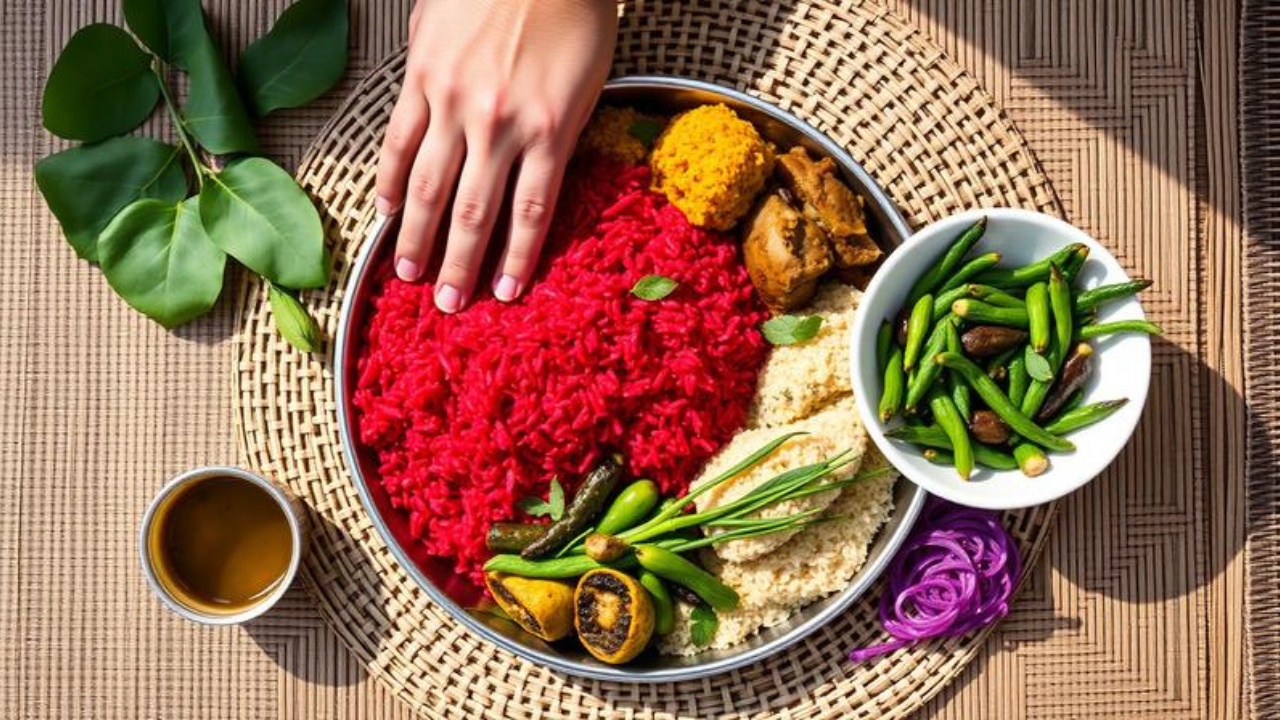
I arrived in Bhutan as a devout vegetarian with low expectations. In my mind, the Himalayan diet meant dried yak meat, bone broths, and polite apologies from hosts offering plain rice. What I found instead was a culinary revelation so fiery, creamy, and deeply satisfying that I barely noticed the absence of flesh. My first meal, served on a sun-drenched terrace overlooking the Paro Valley, was a thali of ruby-red rice ringed with dishes: velvety potatoes tangled with cheese and fresh green chilies, a wild mushroom stew that tasted of damp forest earth, a tangle of wilted ferns in garlicky butter, and a small mountain of ezay—a fresh chili salsa so vibrant it made my pulse thrum. No meat. No apologies. Just an explosion of flavor that felt like a secret whispered across the mountains.
The question this article answers is simple: can a vegetarian—or even a vegan—eat magnificently in Bhutan? The common assumption paints Bhutanese cuisine as a carnivore’s game of dried beef and yak stew. But the truth is far more exciting. Bhutan food vegetarian isn’t an afterthought; it’s the beating heart of a culinary tradition shaped by Buddhist compassion, alpine ingenuity, and an almost religious devotion to chili and cheese. By the time you finish reading, you’ll see why this tiny kingdom might just be your next great plant-based pilgrimage—and you’ll know exactly how to recreate its soul in your own kitchen.
BACKGROUND
Why does vegetarian Bhutanese food matter right now? For starters, the global shift toward plant-forward eating shows no signs of slowing. The number of people identifying as vegetarian or vegan has skyrocketed in the West, and travelers increasingly demand destinations that don’t force them to compromise their ethics. Bhutan, with its philosophy of Gross National Happiness and deep-rooted Buddhist values, sits at a fascinating intersection of ancient vegetarian wisdom and modern conscious travel.
Buddhism arrived here in the 7th century and brought with it the principle of non-harm. While not all Bhutanese are strictly vegetarian, respect for life runs deep. Many families observe meat-free days on auspicious dates, and slaughtering animals is traditionally left to a small non-Buddhist minority. The government has even floated the idea of a nationwide vegetarian day, and the king himself has advocated reduced meat consumption. This isn’t a trend; it’s a millennia-old cultural rhythm that quietly generates an astonishing vegetarian repertoire.
Geographically, Bhutan’s steep valleys and harsh winters shaped a diet built on what could be grown or foraged locally. Before roads connected the country to India, meat was rare, and the daily pot relied on the holy trinity of chilies, dairy, and hardy vegetables like potatoes, radishes, and greens. Today, as Bhutan carefully opens its doors to high-value, low-impact tourism, vegetarian and vegan travelers are discovering a destination that not only tolerates their diet but celebrates it with a riot of color, texture, and spice. This isn’t a place where you endure sad salads—this is where you fall in love with cheese and chilies as a way of life.
THE CHILI-CHEESE CANVAS: EMA DATSHI AND THE VEGETARIAN MASTERPIECES
The cornerstone of vegetarian Bhutanese cuisine is a dish so iconic it practically waves the national flag: ema datshi. At its simplest, it’s fresh chilies simmered with local cheese. But calling it “chilies and cheese” is like calling pizza “bread and tomatoes.” Ema datshi is a silky, fiery, umami-laden stew that works as a sauce, a soup, and a main event all at once. And it’s entirely meat-free.
I watched a young cook named Tashi prepare it in a homestay kitchen in the Haa Valley. She split a dozen large green chilies lengthwise, her fingers moving with the speed of long practice, then tossed them into a pot with a splash of water, a knob of butter, and crumbling chunks of fresh cow’s milk cheese. The secret, she told me, was in letting the cheese melt slowly so it emulsified into the chili liquor, creating a creamy sauce without a drop of cream. The result was otherworldly: the heat was sharp but fleeting, immediately blanketed by the rich, slightly tangy cheese. Served over nutty red rice, it was a complete meal that asked nothing of meat.
From this holy mother dish spring dozens of vegetarian variations. Kewa datshi replaces some or all of the chilies with soft, waxy potatoes, creating a milder, comforting version that even the most spice-averse can love. Shamu datshi brings in wild foraged mushrooms—sometimes delicate oyster mushrooms, sometimes prized matsutake—adding a deep, forest-floor savoriness. In spring, nakey datshi features tender wild fern fronds, their grassy bitterness a perfect foil for the fatty cheese. Each variation honors the same principle: a handful of ingredients, treated with respect, transformed into a dish that feels both rustic and luxurious. For a vegetarian, this is not deprivation; it’s a playground.
BEYOND DATSHI: THE UNSUNG HEROES OF THE BHUTANESE VEGETARIAN TABLE
To limit Bhutanese vegetarian food to cheese and chilies would miss the quietly brilliant supporting cast that rounds out every meal. Start with the canvas: Bhutanese red rice. This short-grain, pinkish-brown rice is a nutritional powerhouse, rich in fiber and minerals, with a nutty chew that makes even plain rice worth eating. It’s the perfect sponge for sauces. At higher altitudes, buckwheat takes over. Puta, the iconic buckwheat noodles of the Bumthang region, are served cold or in a light, tangy broth, often with a heavy scattering of thingey (Sichuan pepper) that leaves your lips buzzing. Buckwheat pancakes, or khur-le, are served with a drizzle of honey or a smear of fresh cheese—an entirely vegetarian breakfast that fueled generations of farmers.
Then come the momos. While meat-filled momos are ubiquitous, vegetable momos are arguably more beloved as a snack that transcends religious observance. Stuffed with finely shredded cabbage, onion, garlic, ginger, and sometimes a whisper of cheese, these pleated dumplings are steamed until translucent and served with a searing chili sauce (ezay). In Thimphu’s weekend market, I sat on a plastic stool eating a dozen vegetable momos, the steam curling into the cold mountain air, and realized I’d never tasted anything purer.
And speak of ezay: this isn’t your standard hot sauce. Bhutanese ezay is a fresh, chunky salsa of chopped chilies, garlic, onion, tomato, and Sichuan pepper, bound with a little oil or cheese. Vegetarian banquets often feature multiple ezay varieties—tomato ezay, garlic ezay, roasted chili ezay—each delivering a different dimension of heat and fragrance. Other unsung heroes include lom (dried turnip leaves) cooked with cheese, and shakam (dried mushrooms) that rehydrate into meaty, savory morsels. The vegetarian landscape is vast and varied, far from the monotonous reputation.
THE BUDDHIST KITCHEN: COMPASSION, HOLY DAYS, AND THE ART OF MEAT-FREE FEASTING
You can’t understand why Bhutan food vegetarian matters without understanding the spiritual backbone that sustains it. Mahayana Buddhism, the dominant tradition here, emphasizes compassion for all sentient beings. This translates into regular vegetarian days (the 8th, 10th, 15th, 25th, and 30th of the lunar month are common) when households across the country cook entirely meat-free meals.
On a visit to a small monastery above Punakha, a young monk named Lopen Namgay invited me to share the midday meal. It was a silent, meditative affair: red rice, a bowl of spinach cooked with cheese, a simple mushroom datshi, and sun-dried chili ezay. Namgay explained that on the full moon day, the entire dzong (fortress-monastery) went fully vegan, eliminating even dairy. “Compassion is not just a word,” he said. “It’s what we put in our bowl.” This is the Bhutanese vegetarian ethos at its purest: not a performance but an integrated practice, centuries old.
For the traveling vegetarian, this means that even outside big hotels, the cultural infrastructure is ready for you. Farmhouses routinely serve sumptuous meat-free thalis. Festivals feature stalls selling vegetable momos and spicy potato balls. And because dairy is not prohibited in most Buddhist contexts, the cuisine never feels spartan. The butter and cheese that anchor datshi dishes come from cows and yaks that roam freely, grazing on alpine pastures—animals that, in the Buddhist worldview, are partners rather than commodities. That philosophical difference infuses the food with a lightness you can taste.
FROM FOREST TO PLATE: THE ORGANIC, WILD SOUL OF BHUTANESE VEGETARIAN FOOD
There’s another compelling reason why vegetarian Bhutanese food resonates today: it’s de facto organic, hyper-local, and deeply connected to the rhythms of the land. Bhutan isn’t just carbon-neutral; it’s carbon-negative. The constitution mandates that 60% of the country remain forested. Chemical fertilizers and pesticides are rare, and most farming is still done by hand. When you eat a mushroom in Bhutan, it was likely foraged that morning from a pine forest, not cultivated in a sterile facility. When you bite into a chili, it came from a terrace carved by your host’s ancestors.
This matters because it makes vegetarian eating here a celebration of pure ingredients. Take matsutake mushrooms, for instance. In late summer, Bhutanese villagers collect these prized fungi from the wild and sell them to Japan and high-end restaurants. Similarly, wild fiddlehead ferns in spring, tender nettles, and even orchid tubers appear in vegetarian stews that are as much medicine as food.
The recent global embrace of farm-to-table dining and foraging menus might look like a trend, but in Bhutan, it’s just Tuesday. That authenticity, coupled with the country’s ban on factory farming and its small-scale agricultural model, makes the vegetarian plate a direct expression of landscape. When you eat kewa datshi in Bhutan, you’re tasting the soil of the Phobjikha Valley. That locavore integrity is something even the most jaded foodie can appreciate, and it’s a persuasive argument for why Bhutan deserves a place on every vegetarian’s bucket list.
COUNTERARGUMENT OR NUANCE
I’d be sugar-coating reality if I didn’t address the elephant—or rather, the yak butter—in the room. Bhutanese vegetarian food is spectacular, but it is not, by default, vegan. Dairy is omnipresent. Cheese, butter, fresh curd, and buttermilk form the backbone of countless dishes, and butter tea (suja) is practically a cultural handshake. If you’re a strict vegan, navigating a traditional Bhutanese menu can feel like walking through a delicious minefield. And outside major tourist hotels, the very concept of veganism can be difficult to communicate.
There’s also the question of variety over an extended stay. As much as I adore ema datshi, after ten consecutive meals dominated by chili and cheese, you might find yourself craving a raw salad or a simple lentil soup—things not native to the high-altitude pantry. Bhutan’s climate limits the vegetable palette; beyond chilies, potatoes, radishes, and seasonal greens, the options shrink. Modern chefs in Thimphu are now blending Bhutanese flavors with international vegetarian dishes (think pumpkin soup with a chili-cheese drizzle), but in rural areas, the rotation can feel tight. This isn’t a flaw so much as a beautiful constraint, and knowing it upfront will help you savor every bowl of mushroom datshi even more.
ACTIONABLE TAKEAWAYS
Ready to bring the soul of vegetarian Bhutan into your kitchen? Here’s how to start:
-
Master the Datshi Method at Home: Don’t have Bhutanese cheese? Feta, queso fresco, or even a mild farmer’s cheese works. Slice fresh green chilies (serranos for mild heat, jalapeños for barely-there warmth), simmer with a splash of water until soft, then crumble in cheese and a pat of butter. Stir gently until creamy. Serve over red rice.
-
Get Acquainted with Red Rice: Source Bhutanese red rice online or substitute with Himalayan red rice or even a short-grain brown rice. Its nutty, mineral flavor is the perfect backdrop for spicy, cheesy sauces.
-
Make Ezay, Your New Favorite Condiment: Roughly chop fresh chilies, garlic, a tomato, and a little onion. Mash together with a pinch of salt and a drizzle of oil. Add a pinch of ground Sichuan pepper if you can find it. Use it to top everything.
-
Fold Your Own Vegetarian Momos: Use store-bought dumpling wrappers or make a simple flour-and-water dough. For the filling, finely chop cabbage, onion, garlic, ginger, and a bit of grated cheese or tofu. Steam and serve with a spicy tomato-ezay.
-
Seek Out Bhutanese Community Hubs: From New York’s Queens to Perth, Australia, Bhutanese diaspora restaurants are emerging. Walk in, order the vegetable momo and kewa datshi, and strike up a conversation. The warmth of Bhutanese hospitality travels well.
FAQS ABOUT BHUTAN FOOD VEGETARIAN
Is Bhutanese food vegetarian-friendly?
Absolutely. Despite the presence of meat dishes, Bhutan has a vast vegetarian tradition rooted in Buddhist principles. Dishes like ema datshi, kewa datshi, shamu datshi, vegetable momos, and buckwheat noodles are inherently meat-free and widely available.
What is the most famous vegetarian Bhutanese dish?
Ema datshi (chili and cheese) is the national dish and completely vegetarian. Its variations with potato (kewa datshi) and mushroom (shamu datshi) are equally beloved and form the core of any vegetarian meal.
Can vegans survive easily in Bhutan?
>>>Traditional Bhutanese food relies heavily on dairy—cheese, butter, and milk—so strict veganism can be challenging, especially in rural homestays. However, upscale hotels and tour operators now readily cater to vegans, and dishes like buckwheat noodles with vegetables, certain lentil soups, and vegetable momos without cheese are adaptable.
Do Bhutanese people eat vegetarian every day?
Many Bhutanese are not fully vegetarian but observe multiple meat-free days each lunar month as part of Buddhist practice. Monasteries and religious communities often follow strictly vegetarian or even vegan diets.
Is vegetarian Bhutanese food very spicy?
Chilies are treated as a vegetable rather than just a spice, so a pleasant heat is central to most dishes. But the burn is balanced by the creaminess of cheese and the nuttiness of red rice. You can always request milder versions by using fewer chilies.
What are some common vegetarian ingredients in Bhutan?
>>>Key ingredients include fresh green and red chilies, local cheese (cow or yak milk), red rice, potatoes, wild mushrooms (like matsutake and oyster), fiddlehead ferns, radish, spinach, buckwheat, and Sichuan pepper.
Where can I find vegetarian Bhutanese food outside Bhutan?
>>>Look for Bhutanese restaurants in cities with immigrant populations—Queens in New York, Toronto, London, and Melbourne all have small but growing Bhutanese eateries. Searching for “Bhutanese momo” or “ema datshi” is a great starting point.
CONCLUSION
Bhutanese vegetarian food is not a compromise or a stripped-down version of a meatier original. It is a complete, confident, and ancient way of eating that predates modern plant-based movements by centuries. Its soul lies in the quiet monastery kitchen where spinach and cheese stews honor the principle of compassion, in the farmhouse where a grandmother’s ema datshi transforms a handful of backyard chilies into a bowl of pure joy, and in the forest where foraged mushrooms deliver a taste of the wild that no factory farm could replicate.
For the vegetarian traveler or home cook, this cuisine is an argument that the most memorable food doesn’t come from complexity or luxury—it comes from an honest relationship with the land and a willingness to embrace bold flavors wholeheartedly. Bhutan reminds us that you don’t need meat to feel warmed, nourished, and fully alive. You just need a little fire, a lot of cheese, and an open heart. In a world hungry for authentic, sustainable, soulful food, the Land of the Thunder Dragon has been setting the table all along. The only question left is: will you take a seat?