
INTRODUCTION
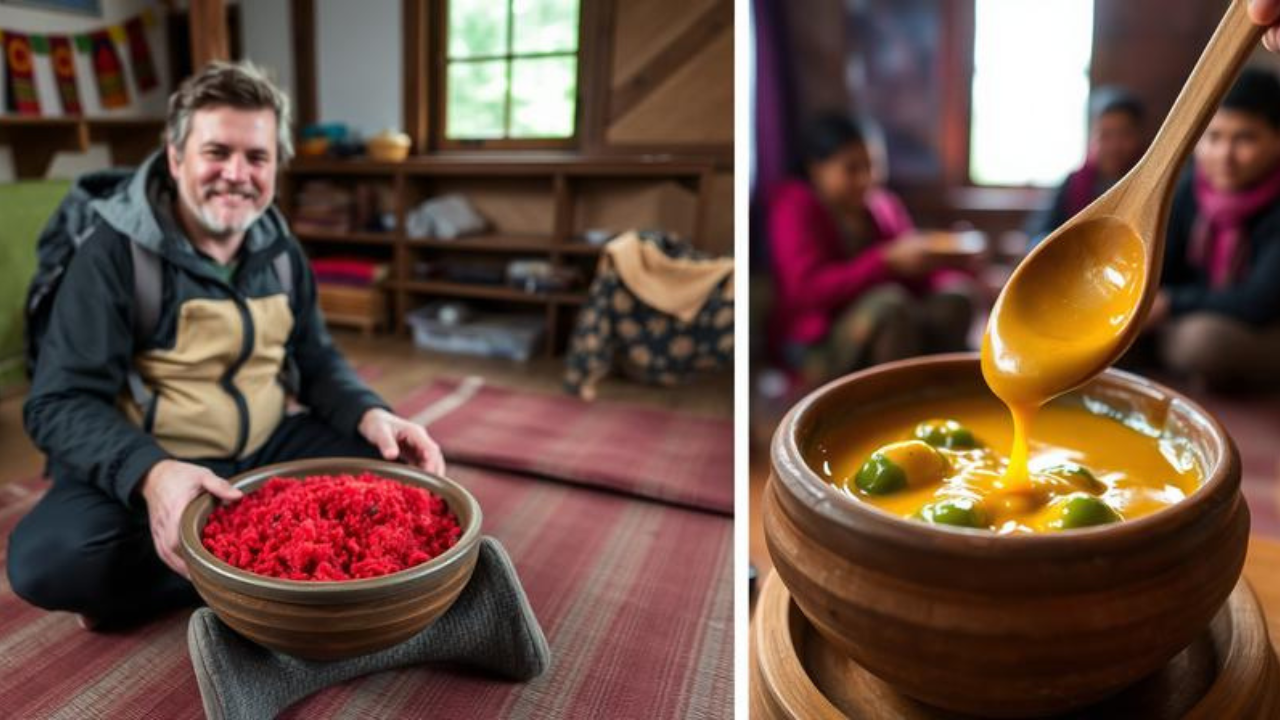
The first time I tasted ema datshi, it wasn’t in a restaurant. I was sitting cross-legged on a wooden floor in a farmhouse kitchen in Bhutan’s Haa Valley, 2,700 meters above sea level, shivering from the thin mountain air. An elderly woman named Aum Pema was tending a blackened pot over an open fire, her face illuminated by the flames. She took a fistful of fat green chilies—easily a dozen—and sliced them lengthwise, dropping them straight into a bubbling pan with a knob of butter and a crumbling of stark white cheese. Ten minutes later, she handed me a bowl of red rice with a ladleful of that molten, pale-orange stew, and said with a wink, “Now you will understand Bhutan.”
She was right. That spoonful rewired my understanding of what food could be. The heat was immediate and electric, yet somehow it didn’t punish—it invited. The cheese coated my mouth in a savory blanket, muting the fire just enough to make you crave the next bite. This was not a sauce or a topping; this was the main event, a dish that treats chili peppers as a vegetable and cheese as a vehicle for courage.
The problem is that outside Bhutan, ema datshi is often misunderstood, reduced to a novelty for spice masochists or dismissed as a one-note peasant stew. I’m here to argue the exact opposite: ema datshi is the most profound, generous, and culturally rich dish you’ve never truly known, and by the end of this journey, you’ll see how a simple pot of chilies and cheese can teach you more about happiness, resilience, and the art of eating than any Michelin-starred creation.
THE BIRTH OF A NATIONAL OBSESSION
To understand ema datshi, you first have to picture a landscape that demands intensity. Bhutan is a kingdom of near-vertical mountains, deep valleys, and winters that linger well past their welcome. For centuries, farming here meant coaxing crops from terraces carved into slopes and surviving on what could be stored through the frozen months. The chili pepper, introduced from the Americas via trade routes in the 16th or 17th century, didn’t just thrive in this harsh terrain—it became a nutritional lifeline. Packed with Vitamin C and capable of making humble ingredients taste celebratory, chilies were adopted not as a spice but as a vegetable, eaten in quantities that would make even a Thai or Mexican cook raise an eyebrow.
The dish itself, ema (chili) datshi (cheese), emerged from this agrarian necessity. It was a farmer’s meal: fresh chilies cooked with whatever cheese was on hand, churned from the milk of the family cow or yak. The name alone tells you everything. It’s a beautifully straightforward union of two ingredients elevated by technique and tradition. Over time, ema datshi climbed from humble hearths to every table in the kingdom—monasteries, royal banquets, roadside stalls—becoming the undisputed national dish of Bhutan. Today, it matters more than ever. As Bhutan carefully opens its doors to global travelers and the world hungers for authentic, unfiltered culinary experiences, ema datshi stands as an edible manifesto. It declares that happiness doesn’t require complexity, that comfort can coexist with fire, and that a nation’s soul can simmer in a single pot.
WHAT EXACTLY IS EMA DATSHI? DECODING THE CHILI-CHEESE MAGIC
At its most essential, ema datshi is a stew of fresh chilies and local cheese, cooked with a little water, butter, and sometimes garlic or onion. That’s it. No spices, no stock, no thickeners. The magic lies in the method and the marriage of heat and fat. Bhutanese cooks typically split large green or red chilies lengthwise—seeds and membranes included—and simmer them in a splash of water until they soften. Then comes the cheese, crumbled into the pot. As it melts, the cook stirs gently, coaxing the cheese into an emulsion with the chili liquor and butter. The result is a creamy, slightly grainy sauce that clings to each chili slice, turning a vegetable into a dish you eat with a spoon.
I watched Aum Pema perform this alchemy with a patience that bordered on spiritual. She didn’t rush the melting. She didn’t measure. Her hand knew exactly when to stop stirring, leaving small, pearly curds suspended in the sauce like little treasures. The cheese she used was chhurpi—a fresh, un-aged cow’s milk cheese with a mild tang and a texture somewhere between paneer and feta. This is the traditional choice, though many households now use commercially produced Bhutanese cheese or even imported processed cheese for a smoother melt. The butter, bright yellow and fragrant, came from a yak that grazed on wild alpine grass. The chilies were the variety simply called “Bhutanese chili” in local markets—moderately hot, fruity, and vibrant.
Bhutanese chili
The flavor profile defies expectations. The heat is front-loaded, a sharp spike that hits the back of your throat. But almost instantly, the dairy floods in with a rich, salty-sweet roundness that transforms the burn into a warm, full-body glow. It’s not about pain; it’s about presence. You can’t eat ema datshi absentmindedly while scrolling your phone. It demands your attention, then rewards it with a rush of endorphins that the Bhutanese have understood for centuries as a direct path to joy.
From this foundational dish, an entire family tree blossoms. Kewa datshi swaps some or all of the chilies for waxy potatoes, creating a milder, more comforting version that soothes even the most spice-averse palate. Shamu datshi incorporates wild mushrooms—chanterelles, oyster mushrooms, or the prized matsutake—infusing the stew with an earthy, almost meaty depth. Khata datshi uses dried red chilies for a smokier, more intense heat. Each variation stays true to the core principle: a handful of humble ingredients, treated with respect, transformed into something far greater than the sum of its parts.
THE SOUL OF A NATION
Ema datshi is not simply a dish. It is Bhutan’s edible identity card, a culinary shorthand for the nation’s philosophy of Gross National Happiness. Consider this: in a country that measures success not by GDP but by collective well-being, the national dish is a pot of fiery comfort designed to be shared. You will never find a Bhutanese person eating ema datshi alone in a corner. It arrives at the center of the table, often in a communal bowl, and everyone dips in with their own spoon or tears off chunks of red rice with their fingers. The act is inherently communal, a daily ritual of connection.
HOW EMA DATSHI EMBODIES BHUTANESE IDENTITY
Its omnipresence is staggering. I’ve eaten ema datshi in a five-star lodge in Paro, where chefs added a swirl of truffle oil. I’ve eaten it at a roadside restaurant where truck drivers ladled it over rice with a speed that spoke of lifelong habit. i’ve eaten it in a monastery kitchen, prepared by monks in silence, its richness the only indulgence in an otherwise spartan existence. In every context, the dish delivered the same message: you are welcome here, you are fed, you are alive. Former Prime Minister Tshering Tobgay once famously said, “If you want to understand Bhutan, start with a bowl of ema datshi.” He wasn’t being poetic. He was being literal.
The Bhutanese relationship with chili is so profound that it borders on the spiritual. Farmers dry strings of red chilies on rooftops, not just for preservation but as a protective symbol, the fiery color warding off evil spirits. Children grow up eating chili-based purees. When a guest arrives unexpectedly, the first instinct is to add more cheese to the pot, stretching the ema datshi as an act of instinctive generosity. This is not a cuisine of restraint. It is a cuisine of wholehearted engagement, and ema datshi is its beating heart.
FROM FARM TO BOWL: THE LAND THAT TASTES THROUGH EMA DATSHI
What makes ema datshi so difficult to truly replicate outside Bhutan is not the technique but the ingredients. Bhutan is one of the few carbon-negative countries in the world, with over 70% forest cover and a constitutional mandate to protect the environment. Most farming is organic by default, not by certification. The chilies in your ema datshi were likely grown on a steep terrace fertilized with nothing but compost, irrigated by mountain streams, and harvested by hand. The cheese came from cows that wandered freely, grazing on wild grasses, clover, and alpine herbs, their milk carrying the faint perfume of a Himalayan meadow.
Himalayan meadow
During a visit to the Centenary Farmers’ Market in Thimphu, I watched as vendors—nearly all women—arranged their produce on tarpaulins. There were heaps of chilies in every shade of green and red, some long and slender, others squat and wrinkled. there were misshapen balls of fresh cheese wrapped in damp cloth, still weeping whey. There were golden slabs of butter, each stamped with a family seal. A seller named Tandin Choden let me taste a sliver of her fresh cheese. It was tangy, milky, with a clean, almost floral finish—nothing like the vacuum-sealed blocks in Western supermarkets. “This cheese is why our ema datshi tastes like home,” she said. “You can use other cheese, but it will only be food. With this, it is memory.”
This terroir-driven integrity is precisely why the dish resonates so powerfully in an era of factory farming and globalized food chains. Ema datshi tastes like a specific place. The water used, the altitude where the chilies ripened, the breed of cow—all of it registers in the final bowl. A version made in the high-altitude region of Bumthang, where yak cheese and buckwheat prevail, is tangier and sharper than one from the subtropical south, where cow’s milk cheese is creamier. To eat ema datshi across Bhutan is to taste the country’s geography, one valley at a time.
COOKING EMA DATSHI AT HOME: BRINGING BHUTAN TO YOUR KITCHEN
You can absolutely make ema datshi outside Bhutan, and you should. The challenge is finding ingredients that honor the spirit of the original without chasing impossible authenticity. Traditional Bhutanese cheese is vanishingly rare abroad, but feta, queso fresco, or a mild farmer’s cheese make excellent substitutes. You want a cheese that crumbles, melts imperfectly, and carries a slight tang—nothing too aged or sharp. Avoid pre-shredded mozzarella, which melts into a stringy, elastic mess. The goal is a sauce with some body and tiny curds, not a smooth fondue.
For the chilies, fresh serranos are the closest readily available approximation. They have a similar bright heat and a thin flesh that softens nicely. Jalapeños work for a milder version, though their thicker walls can make the dish slightly more vegetal. If you can find them, fresh cayenne peppers or Holland chilies are even better. The key is to use whole fresh chilies and resist the urge to remove the seeds. That’s where the soul lives. Start with a modest amount—maybe four or five chilies per person—and work your way up.
A simple home recipe: Slice six fresh green chilies lengthwise. Place them in a saucepan with just enough water to cover the bottom—about a quarter cup. Simmer for five minutes until the chilies soften and the water takes on a faint green hue. Add a tablespoon of butter and swirl until melted. Crumble in a generous half-cup of feta or queso fresco. Stir gently over low heat until the cheese melts into a creamy, slightly lumpy sauce. Add a pinch of salt if needed. That’s it. Spoon it over steamed red rice or short-grain brown rice, and gather people around. The dish must be shared. Eating it alone in your kitchen is missing half the point.
COUNTERARGUMENT OR NUANCE: WHEN THE FLAME BURNS TOO BRIGHT
I must be honest: not everyone will fall in love with ema datshi, and even its most ardent fans admit it can test your endurance. For some palates, the dish is simply too spicy, and no amount of cheese can dial back the fire to a comfortable level. The texture can also unsettle first-timers—the slightly grainy, separated sauce is a far cry from the silky smoothness of a French cheese sauce. Others find the cheese itself an acquired taste, slightly sour and funky in ways that unfamiliar eaters interpret as spoiled.
Then there is the question of monotony. In Bhutan, ema datshi appears at nearly every meal, and a tourist eating three meals a day of guided buffets might groan at its fifth consecutive appearance. The dish is not designed to be a fleeting novelty; it’s designed to be a staple, and staples can become boring if you don’t grow up with them. Health-conscious travelers also note the heavy use of butter and cheese, which, combined with the rice, makes for a calorie-dense plate.
But these critiques are also the very things that make the dish so honest. Ema datshi doesn’t perform for the camera. It doesn’t try to be liked by everyone. It is what it is, with a confidence that most modern food has lost. The slight graininess is proof that real cheese melted in real time. The repetition is a reminder that in a harsh environment, you return to what sustains you. Acknowledging its rough edges only sharpens the argument that this dish is a true culinary artifact, not a polished product.
ACTIONABLE TAKEAWAYS
-
Use Fresh, Whole Chilies: Do not use chili powder or dried flakes. The fresh chili’s grassy, fruity flavor is central. Leave the seeds in for authentic heat.
-
Choose a Crumbly, Slightly Tangy Cheese: Feta, queso fresco, or farmer’s cheese work beautifully. Avoid hard, aged cheeses and processed cheese that melts into liquid plastic.
-
Minimal Water, Maximum Patience: Use just enough water to steam the chilies. The sauce should come from the melting cheese and butter, not from a pool of liquid.
-
Serve Over Red Rice: Bhutanese red rice is available online and adds a nutty, mineral backbone that plain white rice can’t replicate. Short-grain brown rice is the best substitute.
-
Share the Bowl: Ema datshi is a communal dish. Put the pot in the center of the table, give everyone a spoon, and let the conversation flow as freely as the chili-cheese sauce.
FAQS ABOUT BHUTAN FOOD EMA DATSHI
What is ema datshi made of?
Ema datshi is made from fresh green or red chilies, local Bhutanese cheese (similar to a fresh, crumbly paneer or feta), butter, and a small amount of water. Some variations include garlic or onion, but the base recipe is remarkably simple.
Is ema datshi always extremely spicy?
It is always spicy, but the heat level varies. The dairy from the cheese and butter significantly tempers the chili’s capsaicin, creating a warm, glowing sensation rather than a sharp, painful burn. Different varieties of chili and different cheese ratios adjust the intensity.
Can I make a vegan version of ema datshi?
Yes, though purists will say it’s no longer traditional. Use firm tofu blended with a little nutritional yeast, lemon juice, and salt as a cheese substitute, and replace butter with coconut oil or vegan butter. The texture and flavor will differ, but the spicy-creamy spirit endures.
What does ema datshi taste like?
It tastes of bright, fruity heat wrapped in a rich, salty, and slightly tangy cheese sauce. The overall effect is comforting and deeply savory, with a lingering warmth that feels both invigorating and soothing.
What is the best cheese substitute if I can’t find Bhutanese cheese?
Feta is the most commonly recommended substitute. Queso fresco, paneer, and mild farmer’s cheese also work well. You want a fresh, crumbly cheese that doesn’t fully homogenize when melted, leaving small curds in the sauce.
How is ema datshi traditionally served?
It is almost always served with red rice as part of a larger meal that might include other datshi variations, lentil soup, sauteed greens, and meat dishes. It is often eaten with the hands, using the rice to scoop up the sauce.
Is ema datshi healthy?
It is nutrient-dense—chilies are packed with Vitamin C and capsaicin has anti-inflammatory properties—but it is also rich in saturated fat from butter and cheese, and heavy in calories. In the context of a traditional high-altitude lifestyle, it provided necessary energy. Enjoyed in moderation, it’s a wholesome, unprocessed food.
CONCLUSION
Ema datshi is far more than the sum of its two ingredients. It is a bowl of Bhutan’s topographical fury, its Buddhist tenderness, and its quiet, everyday philosophy of happiness. In a world where food is increasingly engineered for maximum stimulation with minimum commitment, this dish asks something braver of you. It asks you to sit with the heat, to trust the cheese, to let your body feel fully alive for the duration of a meal. Every Bhutanese kitchen holds a version of this pot, simmering quietly, ready to welcome any stranger who walks through the door.
The lesson of ema datshi is one I carry with me far beyond the kitchen. It teaches that intensity and comfort are not opposites but partners. That the best things in life don’t require a long list of ingredients. And that sometimes, the surest path to happiness is simply a willingness to let a little fire into your bowl and share it without reservation. So find some fresh green chilies, crumble the best cheese you can afford, and invite someone to your table. The Land of the Thunder Dragon will be right there with you, bubbling gently in a pot.