
INTRODUCTION
Your first spoonful of ema datshi feels like a dare. The steam rising from the earthen pot carries an almost sweet perfume of melted yak cheese, but the moment the sauce hits your tongue, a glorious firestorm erupts. Your eyes water, your pulse quickens, and just as you’re about to surrender, a deep, buttery richness rushes in to cradle the heat. This is the taste of Bhutan, and in this Himalayan kingdom, chili isn’t a seasoning you shake cautiously from a jar—it’s a vegetable you eat by the handful. Bhutanese food might just be the world’s best-kept culinary secret, hidden in the clouds between India and China. It challenges every notion of “spicy” you’ve ever held, yet reduces even the most timid eaters to smiling, sweaty converts. The problem is that too many global food lovers have never tasted it, pigeonholing the cuisine as simply “Indian with more fire” or dismissing it as one-dimensional.
I’m here to argue the opposite: Bhutanese cuisine is a profound, soulful expression of a culture that measures prosperity in joy, not money. This isn’t just a guide to dishes; it’s an invitation to understand how a bowl of chilies and cheese can teach you something about resilience, community, and happiness itself.
BACKGROUND
To grasp Bhutanese food, you first have to look at a map and see mountains—staggering, vertical mountains that slice the country into deep valleys. For centuries, this geography dictated everything. With steep terrain unsuited to large-scale farming and long winters that killed tender crops, the Bhutanese learned to extract maximum flavor and nutrition from a limited pantry. Red rice grew on terraces carved into hillsides. Hardy buckwheat and barley replaced wheat. And perhaps most critically, the chili pepper—introduced from the Americas via trade routes in the 16th or 17th century—didn’t just flourish here; it became a dietary anchor, rich in Vitamin C and capable of making meager ingredients taste like a feast.
Today, this cuisine matters more than ever. Bhutan is cautiously opening to the world, balancing its famous philosophy of Gross National Happiness with controlled tourism. And as travelers seek out destinations that haven’t been flattened by global fast-food chains, Bhutanese food sits at a fascinating crossroads. It’s still radically traditional—most meals in farmhouses come from the family’s own fields and animals—yet young chefs in the capital, Thimphu, are starting to refine it for a global palate. This isn’t a frozen museum cuisine; it’s a living, bubbling pot of adaptation. Knowing what Bhutan eats is knowing the heartbeat of one of the most intriguing nations on earth.
THE NATIONAL OBSESSION: EMA DATSHI AND THE CHILI-AS-VEGETABLE REVOLUTION
Forget what you know about spicy food. In Thailand, bird’s-eye chilies accent a curry. in Mexico, a serrano adds a bright kick to salsa. In Bhutan, chili is the main event. The national dish, ema datshi, translates simply to “chili and cheese,” and that’s exactly what you get: large, fresh green or red chilies, split lengthwise, swimming in a velvety sauce of local cheese. it’s not a topping. It’s not a condiment. It’s the whole point.
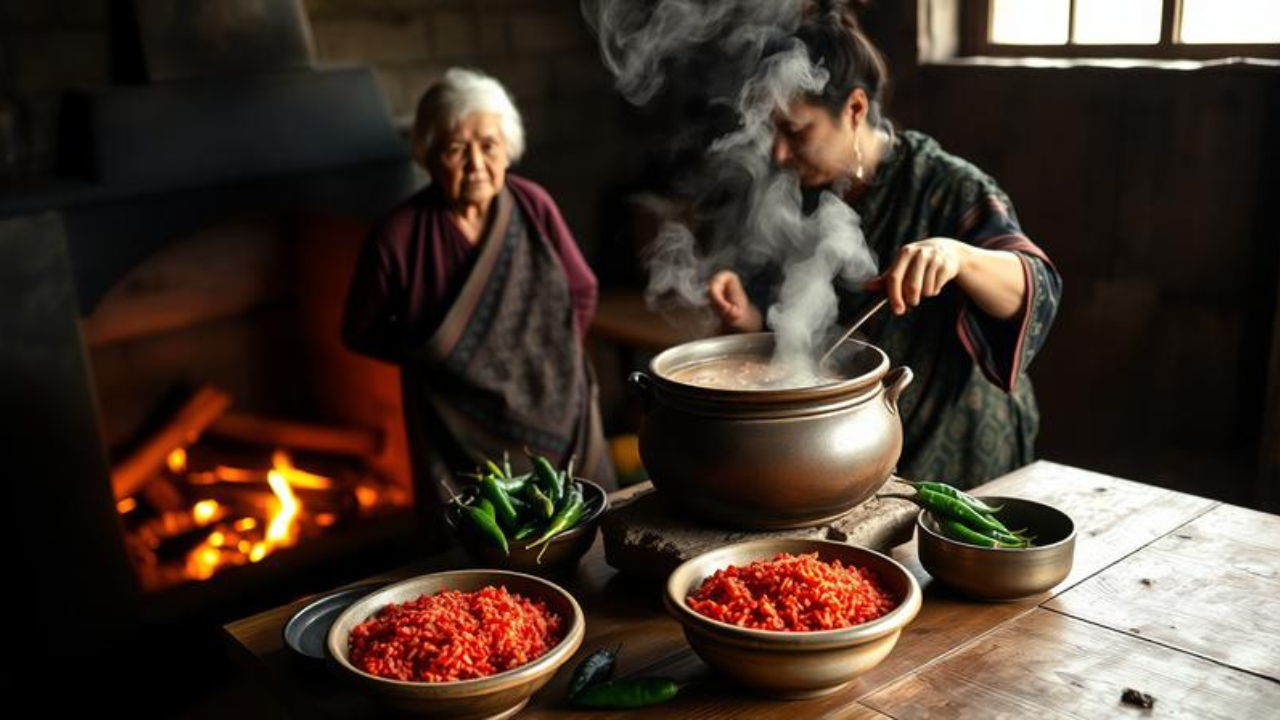
I once sat cross-legged on the wooden floor of a farmhouse in the Punakha Valley, watching a grandmother named Aum Choki prepare lunch over an open fire. She grabbed a fistful of emerald chilies—easily a dozen—and sliced them casually, seeds and all, straight into a bubbling pan. A knob of fresh butter went in next, followed by generous chunks of cow’s milk cheese that melted into glossy rivulets. A few minutes later, she handed me a bowl of red rice piled high with the mixture. “If it doesn’t make your forehead sweat,” she said with a wink, “my ancestors would be ashamed.”
The genius of ema datshi lies in its balance. The dairy fat coats your mouth and tempers the capsaicin just enough to keep the pain pleasurable. Variations abound: kewa datshi adds potatoes for earthy comfort; shamu datshi incorporates wild mushrooms for an umami depth that feels almost Japanese. This isn’t heat for the sake of machismo. It’s a clever, ancient solution to a harsh environment where a steaming, spicy stew can warm the body and preserve food. And it’s deeply democratic—from humble village kitchens to royal palaces, ema datshi is the unifier on every Bhutanese table.
BEYOND THE BURN: THE STAPLES THAT GROUND BHUTANESE COOKING
If you reduce Bhutanese food to just chili-cheese, you miss the sturdy, nutty canvas that holds those bold flavors. First, there’s the rice—specifically, Bhutanese red rice. This isn’t your fluffy white jasmine. It’s a short-grain variety with a pale pinkish-brown hue, a slightly chewy texture, and an earthy, mineral flavor that makes you feel like you’re eating the essence of a terraced hillside. The rice cooks relatively quickly and always arrives as a generous mound, ready to soak up every last drop of sauce. In higher altitudes where rice struggles to grow, nutty buckwheat noodles and pancakes take center stage, especially in the Bumthang region, offering a hearty, gluten-free backbone to meals.
Then there’s the protein. Bhutan is a predominantly Buddhist country, and the act of slaughtering animals is traditionally avoided, but the diet isn’t vegetarian. Most meat is imported from India and appears in vibrant, slow-cooked stews. Phaksha paa is a revelation: slices of pork belly simmered with dried red chilies, whole radishes, and sometimes a handful of wild fern fronds. The radish absorbs the fiery, porky juices and transforms into something you’ll fight for with your dining companions. Jasha maroo, a spicy minced chicken dish flavored with ginger, garlic, and a mountain of chilies, is more like a fragrant, fiery Bolognese than anything you’d find in a Chinese stir-fry.
And don’t overlook yak. In the highlands, yak meat is dried, preserved, and then rehydrated in broths that are as dark as the mountain nights. A bowl of yak stew can taste disarmingly gamey to an outsider, but it’s the pure taste of survival at 4,000 meters. Each ingredient tells a story of place, and none of it is haphazard. The careful dance between heat, salt, fat, and earth is the mark of a confident, ancient culinary tradition.
FERMENTATION, PRESERVATION, AND THE FUNK OF THE MOUNTAINS
If chili is the loud, charismatic frontman of Bhutanese cuisine, fermentation is the mysterious bass player you only notice after a few songs—but once you do, you can’t stop listening. In a land with no refrigeration until very recently, preserving food was a sacred art. This gave rise to flavors that are funky, sour, and gloriously complex.
Let’s talk about cheese, but not the melted kind in your ema datshi. Chhurpi is a rock-hard, dried yak cheese that you don’t so much eat as negotiate with. Villagers tuck a piece into their cheek and chew meditatively for hours, releasing a subtly smoky, sour milkiness. There’s also zoedey, a fresh, soft cheese similar to paneer but tangier, often crumbled into soups. Beyond dairy, sinke (fermented radish) and tshoem (fermented greens) deliver a probiotic punch and a sour sting that cuts through rich meat dishes.
Perhaps the most surprising ingredient is the Sichuan pepper, known locally as thingey. Unlike the chili heat, thingey delivers a tingling, almost electric numbness that dances on your lips, turning an ordinary broth into a sensory playground. My first encounter with it came in a bowl of puta, buckwheat noodles in a thin, sour buttermilk broth, speckled with dried fish and a heavy dash of thingey. Each slurp was a one-two punch: first the cold, sour tang of the buttermilk, then the buzzing warmth that left my whole mouth vibrating. it was weird. It was wonderful. It was like nothing else. These funky, fermented, and tingly dimensions prove that Bhutanese food isn’t a monolith of heat; it’s a full-spectrum sensory assault, carefully tuned over centuries.
FOOD AS A RITUAL: HOW GROSS NATIONAL HAPPINESS TASTES
You cannot understand Bhutanese food without understanding that eating here is an act of spiritual and communal necessity. Bhutan’s development philosophy, Gross National Happiness (GNH), prioritizes collective well-being over economic output, and that spirit infuses every meal. Food is shared. Plates are refilled before they’re half empty. Saying “no” to a second helping of ara—the warm, cloudy home-brewed grain alcohol—might cause genuine, furrowed-brow concern from your host.
In a Bhutanese home, the family often gathers on the floor around the bangchung, a beautifully woven bamboo basket that serves as a table. Everyone dips from shared bowls. The conversation is boisterous, punctuated by sharp intakes of breath as someone bites into a particularly vicious chili. This is deliberate. A meal isn’t fuel; it’s the day’s central ritual of connection. The Bhutanese have a saying, often shared with guests: “Mey na, mey na” — “Eat, eat.” It’s not just politeness; it’s an invocation of abundance in a land that knows scarcity.
Even the humble butter tea, or suja, speaks to this philosophy. Made from tea leaves boiled for hours, then churned with yak butter and salt, it’s more like a savory soup than a beverage. Foreigners often grimace at their first salty, oily sip, but by the third cup, shivering at altitude, you realize it’s a liquid hug. It sustains, warms, and connects you to every nomad who sipped it before. The cuisine’s unapologetic intensity—why would you eat a mild chili when you could feel this alive?—is a daily, edible reminder of the Bhutanese commitment to feeling deeply. You don’t numb yourself with bland food here; you wake up.
COUNTERARGUMENT OR NUANCE
I’d be a dishonest journalist if I didn’t admit that not everyone falls in love with Bhutanese food, and even devoted fans sometimes crave a break. For many first-timers, the sheer omnipresence of chili and cheese can feel repetitive. A traveler I met in Paro joked that after a week, he’d have traded his kingdom’s inheritance for a plain green salad without any sign of a pepper. The cuisine’s heavy reliance on dairy and meat can also be challenging for vegans, though plant-based options are growing slowly in tourist lodges. And historically, the limited traditional vegetable cultivation—beyond chilies, radishes, and potatoes—meant menus could lack the produce-driven variety you find in, say, Mediterranean food.
Furthermore, there’s a real tension between preservation and modernization. As processed snacks and sugary drinks creep in from across the border, Bhutan is grappling with its own health transitions. This is the complexity: a cuisine born of geographic isolation and ingenious scarcity now faces the lure of global convenience. It’s not a perfect, fairy-tale food utopia; it’s a real, living food culture with tensions. But perhaps that very tension—the push to preserve the ferocious soul of ema datshi while adapting to a changing world—makes it all the more vital to appreciate right now.
ACTIONABLE TAKEAWAYS
Ready to let Bhutanese food change your palate? Here are five ways to start exploring, no plane ticket required:
-
Begin with a Potato Bridge: If pure chili-cheese terrorizes you, make kewa datshi. Boil cubed potatoes with sliced fresh chilies, then stir in a generous knob of butter and crumbled feta or queso fresco. The potato softens the blow while letting the authentic flavor through.
-
Hunt Down Red Rice: Swap white rice for Bhutanese red rice (available online or in specialty grocers). Its nutty chew and pink hue make any stew feel Himalayan. Cook it in double the water, simmer for 20 minutes, and let it steam dry.
-
Embrace the Fresh Chili Lifestyle: In Bhutan, they don’t use dried chili powder in everything. Buy fresh serranos, jalapeños, or milder green chilies, and treat them as the star of a stir-fry, not just a seasoning agent.
-
Try a Salted Tea Experiment: Brew a strong black tea. Put a pinch of salt and a tiny sliver of butter into your cup before pouring. It sounds bizarre, but it’s your one-way ticket to understanding high-altitude comfort.
-
Find Your Nearest Bhutanese Community: Little Bhutanese restaurants are popping up from Queens, New York, to Melbourne. Walk in, order the ema datshi and jasha maroo, and tell the server it’s your first time. You’ll likely get a smile, a cup of suja on the house, and a glorious lesson in happiness.
FAQS ABOUT BHUTANESE FOOD
What is Bhutan’s national dish?
The undisputed national dish is ema datshi, a fiery stew of fresh chilies cooked in a cheese-based sauce. It comes in many variations with mushrooms, potatoes, or dried beef, but the essential chili-cheese core remains constant.
Is Bhutanese food always extremely spicy?
Yes and no. Chilies are a main ingredient in most dishes, so a baseline heat is almost unavoidable. However, the spice level is tempered by dairy, rice, and starchy vegetables. Many dishes offer a complex heat that feels warming rather than punishing, and you can request milder versions in tourist-friendly spots.
What is the main staple of the cuisine?
Red rice is the primary staple across most of the country. In higher-altitude regions like Bumthang, buckwheat noodles (puta) and buckwheat pancakes (khur-le) replace rice, offering a gluten-free, earthy alternative.
Is Bhutanese food vegetarian-friendly?
It can be. Because of Buddhist principles, many Bhutanese people avoid meat on certain holy days, so vegetarian dishes like kewa datshi (potato and cheese), shamu datshi (mushroom and cheese), and various fern and cheese preparations are widespread. However, pure vegans may struggle outside major hotels, as butter and cheese are foundational.
What is suja and why is it salty?
Suja is Bhutanese butter tea, made by churning boiled tea leaves with yak butter and salt. It’s salty rather than sweet because it’s intended to be a nourishing, high-calorie beverage that replenishes salt and energy at high altitudes, functioning more like a broth than a typical tea.
What is ara and how is it served?
Ara is a traditional grain alcohol brewed from rice, barley, or maize. It’s usually served warm, often with a pat of butter melting on top for extra richness. It’s an essential part of hospitality, offered to guests alongside snacks like beaten rice or fried eggs.
Can I easily find Bhutanese restaurants outside of Bhutan?
While still rare, Bhutanese eateries are emerging in cities with expatriate populations—notably New York, Toronto, London, and Melbourne. Many are humble, family-run spots. Searching for “Bhutanese momo” or “ema datshi” online is a good starting point, and the small community is famously welcoming to curious newcomers.
CONCLUSION
Bhutanese food isn’t about complexity of technique or a parade of rare ingredients. It’s about intensity of spirit. It asks a simple question: what happens when you stop being afraid of a little heat and lean fully into the flavors that nature gave you? The answer, as every smiling, sweat-drenched Bhutanese grandmother will show you, is a profound sense of aliveness. From the bubbling pot of ema datshi that never leaves the stove to the funky, fermented undercurrents of mountain cheese and Sichuan pepper, this is a cuisine that reflects the landscape—dramatic, layered, and unforgettable.
In a world increasingly dominated by safe, Instagram-friendly food that tastes politely of nothing, Bhutan offers a culinary rebellion. It’s an edible argument that food should sometimes be a beautiful struggle, a moment of connection, and a reason to sit shoulder-to-shoulder on a wooden bench, passing a single bowl. So, the next time you look at a plain green chili in your kitchen, consider it as more than a sidekick. Crumble some cheese into a pan, throw that chili in whole, and taste what the Land of the Thunder Dragon has been whispering all along: the path to happiness might just be lined with fire.